City of Allen Website Improvements
Role
Digital Experience / UX Content Designer
Services
Content strategy, IA, accessibility, UX improvements
Tools
CMS, Figma, Adobe Creative Suite, Google Analytics, Acquia Optimize (accessibility), Canva
Timeframe
Ongoing
Status
🟢 Shipped
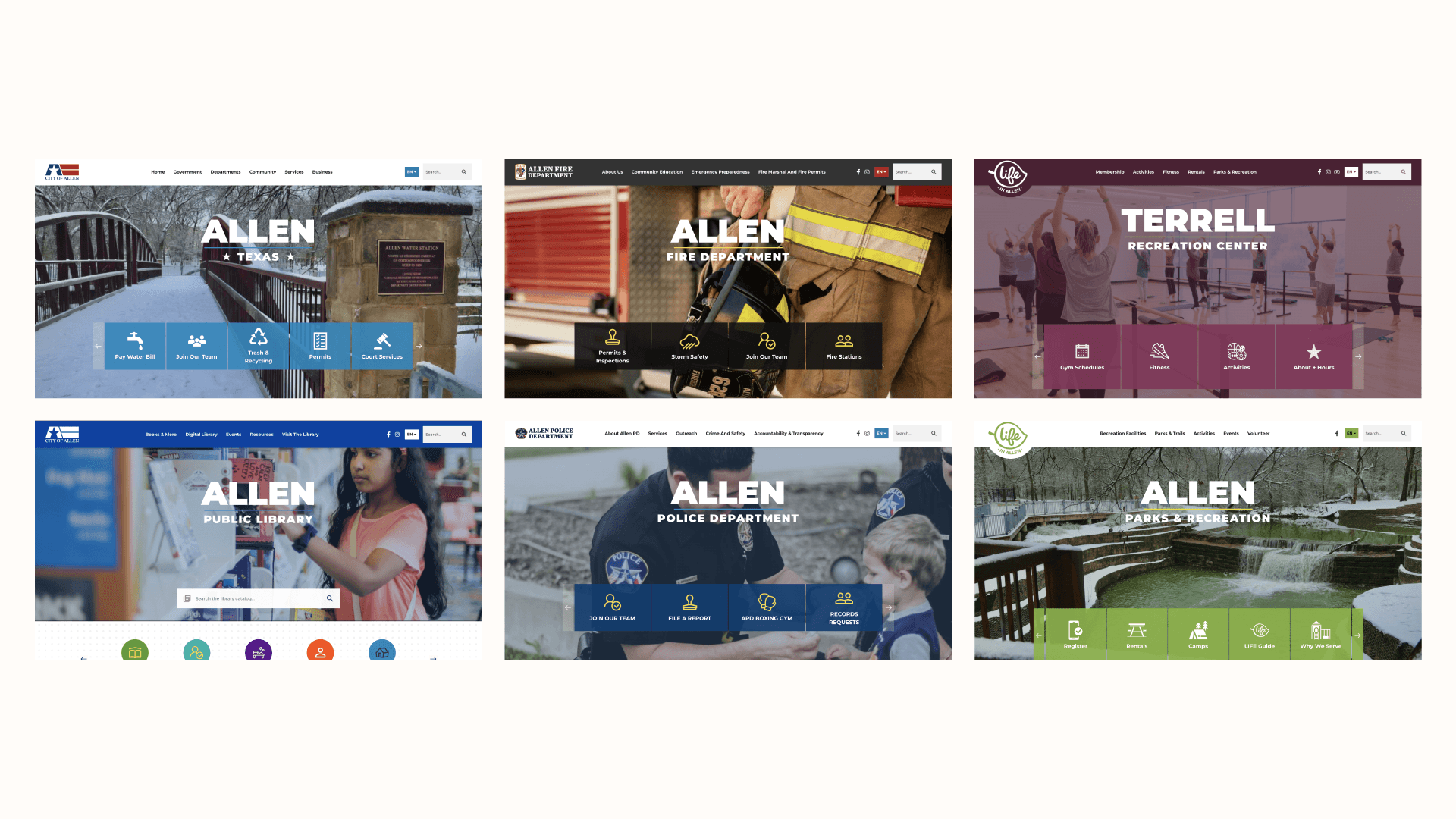
While working as a Communications Coordinator for the City of Allen, I led UX and content improvements across several high-traffic, public-facing web pages following a platform migration and team transition. This work focused on improving clarity, accessibility, and usability across live municipal content—often under tight CMS constraints and with diverse stakeholder needs. Rather than redesigning the site from scratch, my role centered on identifying friction in real user journeys and iteratively improving existing pages through UX principles, content restructuring, and visual hierarchy.
01
Context & Constraints
Municipal websites present a unique design environment: they serve a wide audience, carry legal and accessibility obligations, and operate within rigid technical and organizational constraints. When I stepped into this role, the city’s website had recently migrated to a new CMS after the departure of a Senior Web Content Specialist. Many pages relied heavily on dense text, outdated layouts, or desktop-first patterns that did not translate well to mobile or assistive technologies.
Key constraints included:
A fixed CMS with limited layout and component flexibility
Live pages with high visibility and no tolerance for downtime
Strict accessibility standards (WCAG) and public accountability
Content authored by multiple departments with varying goals and voices
Political and community sensitivity, particularly on public safety pages
Within these constraints, my focus was on making incremental, high-impact improvements that reduced cognitive load, improved wayfinding, and made information easier to understand for residents.
02
My Role & Approach
I served as one of the primary web contacts for multiple departments, collaborating with subject-matter experts while independently executing UX and content improvements. My approach combined UX auditing, content strategy, and accessibility best practices.
My responsibilities included:
Auditing high-traffic pages to identify usability and accessibility issues
Restructuring information architecture to improve scannability and task completion
Translating walls of text into structured, user-friendly content
Improving mobile usability within existing CMS components
Applying visual hierarchy and imagery to humanize civic content
Ensuring accessibility through semantic structure, contrast, and navigation patterns
Rather than focusing on aesthetics, I prioritized clarity, trust, and ease of use, especially for residents interacting with critical public services.
03
Selected UX Interventions
Below are representative examples of how I applied UX principles to improve live municipal pages. Each intervention reflects a different type of user problem and design constraint.
Allen Police Department — About Allen PD Redesign
This page serves as the primary entry point to the Police Department’s About section of the site and receives significant public traffic. The original layout relied on a dense, table-based structure that was difficult to scan, unfriendly on mobile, and impersonal in tone.
Key improvements:
Replaced an ADA-unfriendly table with a tile-based layout for divisions and units
Elevated the department’s mission, values, and motto to establish trust and transparency
Introduced visual hierarchy and imagery to humanize officers and first responders
Improved navigation clarity for users seeking specific units or services
The redesign balanced approachability with professionalism while improving accessibility, scannability, and usability across devices.
Parks & Recreation — Usability Fix
A resident identified a location hours table that was difficult to read on mobile. Upon reviewing the experience, I found the table was fixed and did not scroll properly, making key information inaccessible on smaller screens.
Key improvements:
Converted a dense table into a simple, mobile-friendly bulleted format
Preserved all required information while improving readability
Ensured alignment with accessibility and responsive design principles
This small but timely change significantly improved usability for residents accessing information on the go. We continue to collaborate with our website provider to advocate for more mobile-friendly CMS layouts, particularly as more than half of our users access the site via mobile devices.
Allen Fire Department — History Page
A large volume of historical content was presented to our team as a single block of text, with a goal to copy and paste it onto the page. While informative, it was difficult for users to read, navigate, or reference.
Key improvements:
Split long-form content into year-based sections for easier comprehension
Added anchor links and “back to top” navigation to support wayfinding
Paired text with relevant imagery of stations, equipment, and milestones
Reduced cognitive load while preserving the department’s full history
This intervention focused on readability, narrative flow, and respectful storytelling—making complex historical content easier to navigate within a public service context.
Allen Police Department — Outreach Pages
These pages were among the first projects I completed after joining the team, and focus on strengthening community connection through digital storytelling. Both initiatives support the department’s goal of humanizing the badge by highlighting youth programs and officer-led conversations.
Key improvements:
Created clear page structures using section anchors and buttons
Translated unstructured content into scannable, user-centered layouts
Repurposed existing CMS components to support ongoing content updates
This work demonstrates how thoughtful information architecture and creative use of existing CMS tools can improve engagement and trust for community-focused programs—without changing underlying content or requiring new technical components.
04
Result
These interventions improved clarity, accessibility, and usability across several high-traffic public-facing pages without disrupting live content or existing technical systems. By restructuring information architecture, improving mobile readability, and introducing consistent visual hierarchy, the updated pages better support residents completing real tasks—whether learning about public services, attending community programs, or accessing time-sensitive information.
Rather than owning a single “shipped” product, I supported a set of evolving digital experiences used by residents every day. I applied UX thinking to content-heavy, high-visibility systems—introducing repeatable content patterns and layout approaches that improved consistency across departments while reducing the need for ad-hoc fixes.